








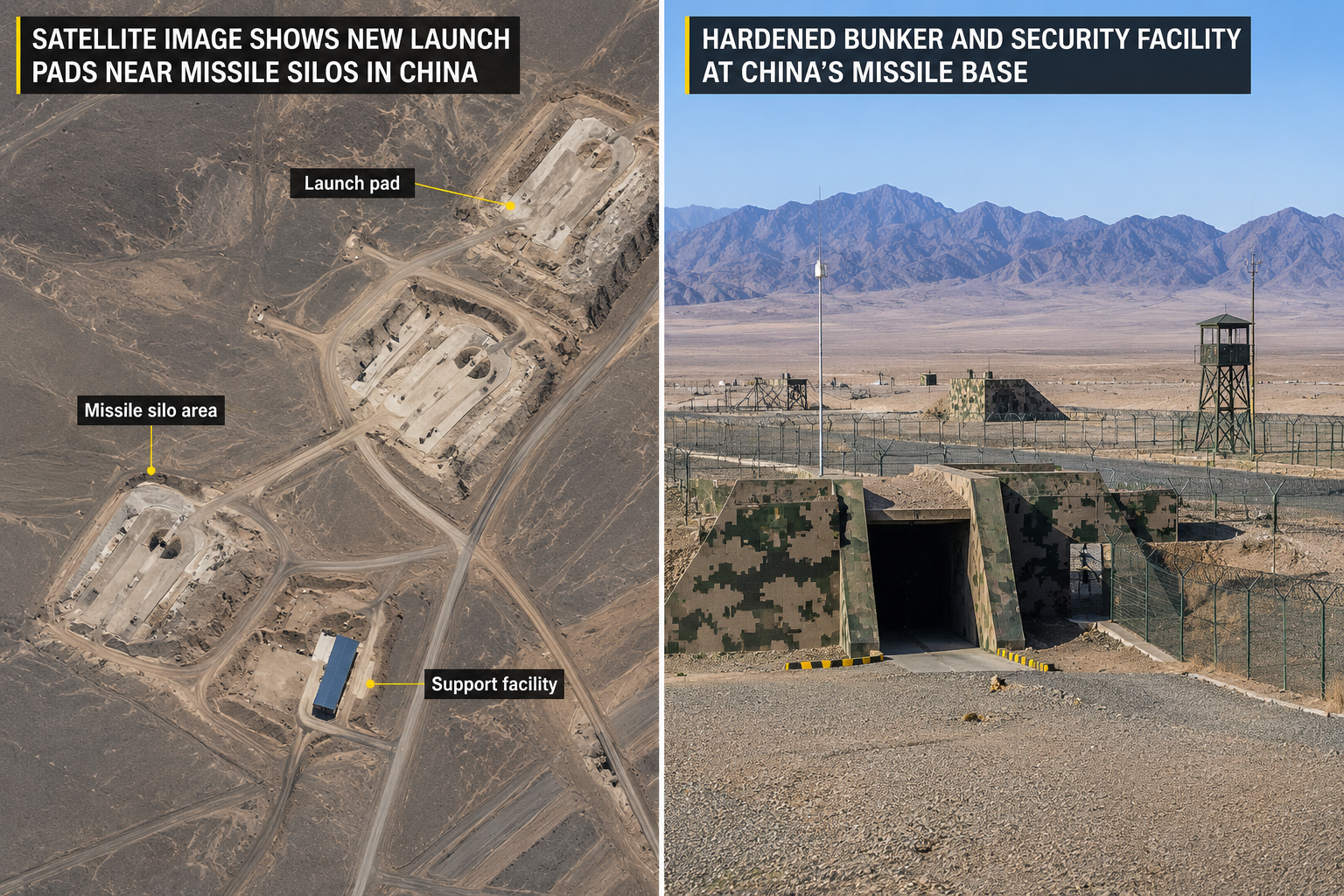
Satellite images show launch. New satellite photographs of China show large-scale military building of bases and facilities around several of its nuclear missile silo fields, bringing China back into the center of global strategic considerations. Analysed by defence experts and intelligence researchers, the images suggested Beijing was constructing bunkers, communication facilities, defensive installations and other support structures around key nuclear missile facilities. Security experts around the world have been closely watching the development and it is seen as a reflection of China’s ongoing nuclear modernization and strengthening its nuclear deterrent.
The new data is released in the backdrop of growing geopolitical tensions in the Indo Pacific. As the competition between China and the United States continues, the persistent security issues regarding Taiwan and the rising military activity in the South China Sea, China’s growing nuclear arsenal is poised to have significant impacts on global security and strategic stability.
Satellite images show launch pads and extensive military construction plans.Satellite imagery shows the large scale plans for military construction.
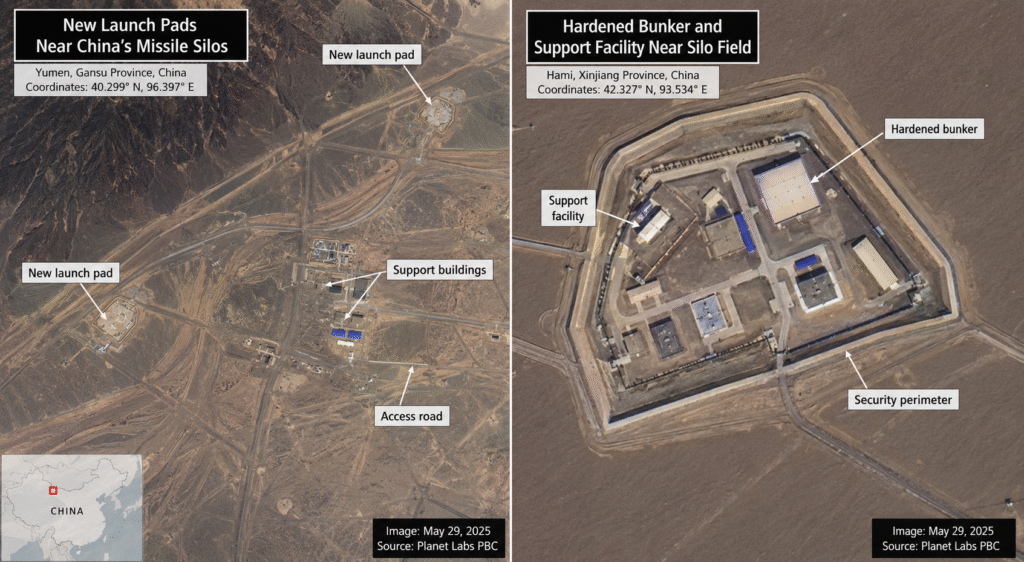
Any recent commercial satellite imagery has offered a detailed view of the construction work in the vicinity of China’s nuclear missile silo complexes. The analysts that have taken a look at the images have discovered numerous launch pads, hardened bunkers, communication towers, roads, support structures and other military installations throughout extensive desert areas.
Many of these developments are reportedly near China’s Hami missile silo field and other strategic military bases in the country’s western regions. The massive scale of the construction indicates that China is not only upgrading existing facilities but building a more advanced and resilient nuclear infrastructure network.
The structures that have been discovered seem to be in strategic locations that would make them ideal for China’s expanding intercontinental ballistic missile (ICBM) armament. The facilities are thought to enhance the operational readiness, survivability and command and control of China’s nuclear forces
Understanding China’s Nuclear Missile Silos
Nuclear missile silos are structures built on the surface of the ground that are designed to be very secure, and to hold long-range ballistic missiles. They are designed to be attacked and then used to store safe nuclear weapons when necessary.
China’s intelligence reports and satellite images have revealed that over the last several years it has been building hundreds of new missile silos in remote areas. This expansion was a major change in China’s traditional nuclear deterrence strategy that has historically been conducted with a much smaller nuclear arsenal than the United States and Russia.
New construction activity suggests that Beijing is now putting significant resources into the building of supporting infrastructure around these missile areas. Instead of just expanding missile silos, China seems to be building an entire military ecosystem that will improve the capabilities of its nuclear forces.
Why China is building launch pads near missile silos?
The newly found Satellite images show launch pad have multiple strategic uses, defense experts believe.
A potential reason is that they are meant to be used with mobile missile launchers. Mobile missile systems can be transported over a wide range of area, thus making them difficult to detect and target. With the help of the two technologies, China would be able to enhance the survivability of its nuclear forces in the event of a conflict.
The launch pads can also be used for missile tests, training runs, maintenance or deployment. Their close proximity to the missile silos means that they are part of China’s overall nuclear defense plan.
Military experts also point out that the installations have the potential to be used as air defense installations to defend nuclear facilities against air attack. These systems might range from surface-to-air missiles to radar installations and electronic warfare gear that interferes with an enemy’s surveillance and targeting capabilities.
Construction of Fortified Bunkers Raises Questions.
One of the most important findings in the satellite photos is the large number of bunkers being constructed close to the missile silo fields.
These bunkers are thought to house military hardware, command staff, communications equipment, and maybe other missile-related equipment or resources. The reinforced construction shows that they are likely to withstand attacks and continue working even in the event of a major military conflict.
Bunkers are a sign that China is putting a high priority on operational continuity during crisis. Beijing will be able to enhance its coordination capabilities under difficult conditions by establishing safe command and support areas.
According to security experts these facilities might be vital to continuing command and control capabilities, which are key to any nuclear deterrence strategy.
Identified improved Communication Networks.
Satellite images show launch pads has also shown large groups of communication equipment near the missile sites. The communication towers, transmission facilities and support structures have been identified around several of the locations.
Communication is a key component of modern nuclear forces. Military officials need to be able to send and receive messages, intelligence updates and respond in various areas.
The development of sophisticated communication systems indicates that China is making efforts to increase the speed and connectivity of its strategic assets. These systems can be satellite communications, secure military communications networks, and backup communications in case of emergencies.
It is thought that enhancing communication skills is a key element of China’s military modernization.
China’s Military Modernization Program refers to China’s efforts to modernize its military forces.
The Continuous Improvement of Military Capitals (CI-MC) is an extended military modernization program that has been in progress for several years.
China, under the leadership of Chinese President Xi Jinping, has a lot of money to invest in modernizing its armed forces. Included in this effort are improvements in naval force, air defenses, cyber, space and strategic missile forces.
Beijing has repeatedly said that its military modernization is for the sake of national security and national sovereignty. The Chinese government has also underscored the need for a credible nuclear deterrent in today’s complex international landscape.
It seems that the construction of launch pads, bunkers and support facilities around missile silos correlate well with these overall modernization goals.
Growing Concerns in Washington
The newest satellite pictures have brought a lot of attention to the United States, where both politicians and military leaders are tracking China’s military advances.
American defense evaluations have been raising questions about the tempo of China’s nuclear buildup over and over again. Bigger military power is potentially shifting the balance of influence among the great powers and complicating future arms reduction negotiations, according to U.S. officials.
The U.S. now has one of the world’s biggest nuclear inventories, second to only Russia. But experts estimate China is building up its arsenal faster than previously thought.
China is planning more build up around these launch sites, and is clearly gearing up for a future where nuclear deterrence becomes an even bigger part of its national security posture.
The growth of China’s nuclear arsenal continues.
There are several reports of China building up its nuclear arsenal at a considerable rate for the next 10 years.
If Beijing follows current trends, it is estimated that the country could have around 1,000 nuclear warheads by 2030. This will be fewer than the nuclear stockpiles of the United States and Russia, but still a massive escalation from the previous nuclear strength of China.
An increase in missile silos, launch facilities and supporting infrastructure is seen as a gauge on this growth.
Many analysts suspect that China is trying to build a more multi-domain, resilient nuclear arsenal that can function on land, sea and air.
Impact on Global Security
China’s nuclear growth is likely to affect global security in many ways.
The developments are being closely watched in countries around Asia, Europe and North America. The United States’ regional partners such as Japan, South Korea and Australia are worried about the changing military landscape in the Indo-Pacific region.
Meanwhile, military planners in Washington and other capitals are assessing the implications of the Chinese’s new capabilities for deterrence policies, military cooperation arrangements, and military planning.
The development of new launch pads and bunkers could also shape the future arms control agenda of the big nuclear states.
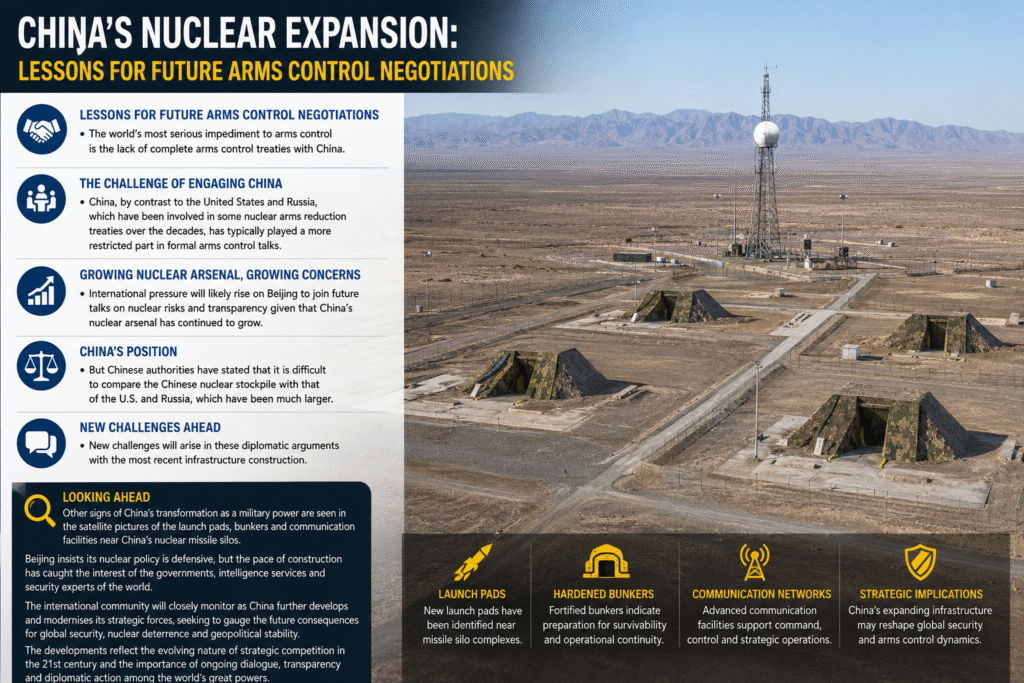
Lessons for future arms control negotiations.
The world’s most serious impediment to arms control is the lack of complete arms control treaties with China.
China, by contrast to the United States and Russia, which have been involved in some nuclear arms reduction treaties over the decades, has typically played a more restricted part in formal arms control talks.
International pressure will likely rise on Beijing to join future talks on nuclear risks and transparency given that China’s nuclear arsenal has continued to grow.
But Chinese authorities have stated that it is difficult to compare the Chinese nuclear stockpile with that of the U.S. and Russia, which have been much larger.
New challenges will arise in these diplomatic arguments with the most recent infrastructure construction.
Looking AheadOther signs of China’s transformation as a military power are seen in the satellite pictures of the launch pads, bunkers and communication facilities near China’s nuclear missile silos.
Beijing insists its nuclear policy is defensive, but the pace of construction has caught the interest of the governments, intelligence services and security experts of the world.
The international community will closely monitor as China further develops and modernises its strategic forces, seeking to gauge the future consequences for global security, nuclear deterrence and geopolitical stability.
The developments reflect the evolving nature of strategic competition in the 21st century and the importance of ongoing dialogue, transparency and diplomatic action among the world’s great powers.