




Introduction
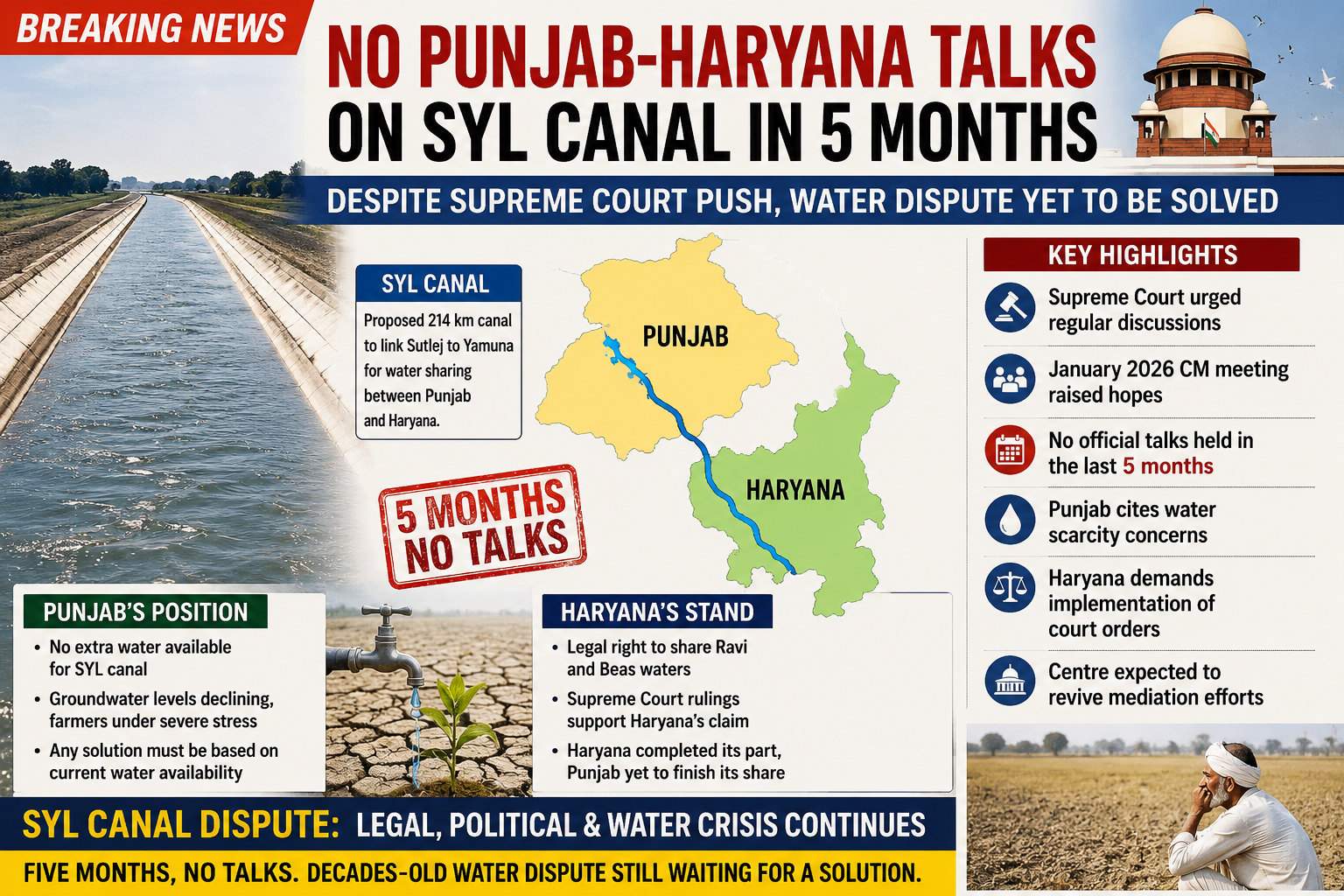
Punjab and Haryana .The Sutlej-Yamuna Link (SYL) Canal conflict between the two sister states has again come to the fore in the wake of reports that even after the Supreme Court of India had given several directions and assurances, the states have been without any official discussions over the matter in the past five months. The development has stirred yet again the future of one of India’s most controversial inter-state water disputes.
It isn’t just a canal-building problem. It is about water rights, farming requirements, political interests, environmental concerns, and legal issues which have raged for decades. The Supreme Court has repeatedly urged both these states to hold talks and reach an amicable resolution, but that seems to have made little headway.
There have been no official talks between the two States on the issue despite the earlier this year commitment made by the Chief Ministers of Haryana, Nayab Singh Saini and Punjab, Bhagwant Mann. The absence of this engagement has led to a receding sense of the future of the project and implementation of court directions. Punjab and Haryana
What is SYL Canal Project?
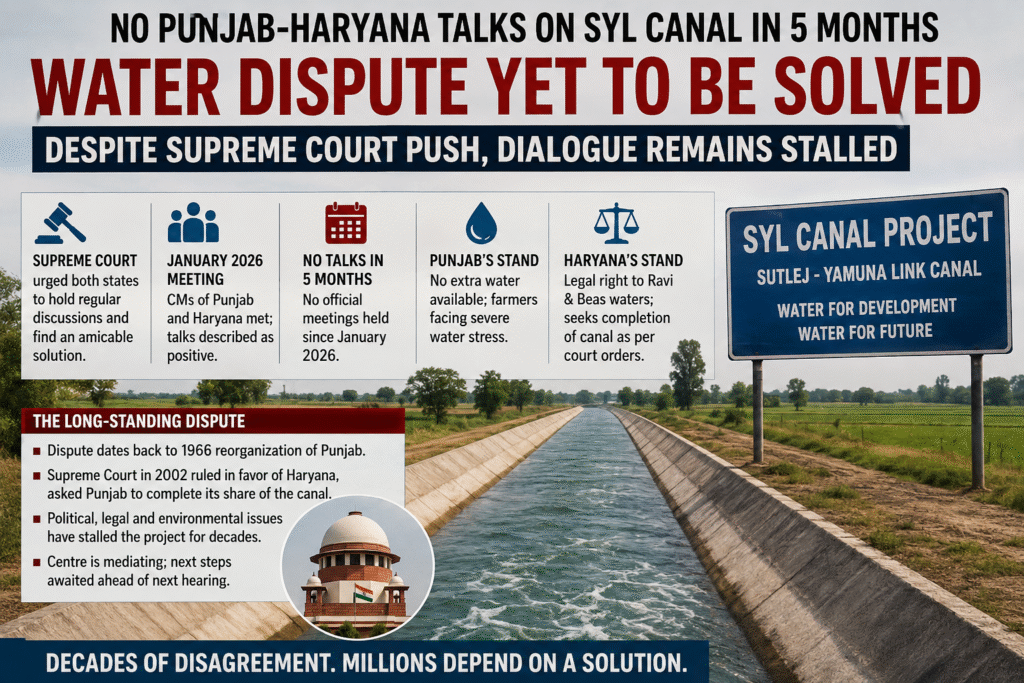
Sutlej-Yamuna Link Canal is a canal proposed to allow sharing of water from Ravi and Beas rivers between Punjab and Haryana.
The project will entail a canal of 214Km. Of this, about 122 kilometres are in Punjab and 92 kilometres are in Haryana. The canal was supposed to transport excess water from the rivers of Punjab to irrigate Haryana, to meet the demand of water in this state.
The state of Haryana finished its canal several years ago. Despite decades of planning and legal action, however, the section of the project in Punjab is yet to be finished, leaving it a project that is still not complete.
A brief history of the controversy.Brief Summary of the Controversy.
Punjab and Haryana. The issue goes back to the reorganization of Punjab in 1966 when Haryana was established as a separate state.
After the division, there was a conflict regarding sharing of the river water of the Ravi and Beas river. Haryana claimed it was due to a fair share of water resources and Punjab had said its demand was growing and it couldn’t take more water.
This controversy was addressed in several agreements, tribunals, and court cases throughout the years. The canal’s construction started in the early 1980s, but was stalled by a number of political, public and legal problems.
The matter got even more complicated when the Punjab governments over the years claimed that there was no surplus water available for sharing. While it was being discussed, Haryana had been pressing for implementation of the previous agreements and court orders.
The Supreme Court’s function in the case.
Punjab and Haryana.. For decades, the SYL dispute has been at the heart of the Supreme Court.
The apex court in 2002 had ruled in favour of Haryana and asked Punjab to finish its share of the canal. But the implementation was not advanced because of political and administrative problems.
In the last few years, dialogue and cooperation have repeatedly been highlighted by the court over confrontation. The Supreme Court in May, 2025 had directed Punjab and Haryana to take steps to reach out to Union government and reach an amicable resolution of the matter. Additionally, the court urged routine meetings between the states to come up with feasible solutions.
The Centre then began its mediation process with representatives from both states.
January 2026 Meeting Offered Hope
Much headway was made in January 2026 when Punjab Chief Minister Bhagwant Mann met Haryana Chief Minister Nayab Singh Saini to discuss the canal dispute.
Both leaders commented on the meeting being positive and constructive afterward. Officials from both states would keep talking and meeting often, they said, to try to settle the differences on a public forum.
It was hoped that the continual contact between the irrigation departments and high-ranking officials would help to resolve the impasse that had been going on for years. The two leaders highlighted the need to safeguard the interest of both countries and seek a mutually acceptable solution.
No Meetings Held in Five Months
Nothing so far has been done by both the official bodies of Punjab and Haryana on the SYL issue in the last five months despite the commitments made in January.
This is of special importance, given that the Supreme Court had said that dialogue was important. There have been no discussions, meaning progress towards a negotiated settlement has stalled.
The Punjab government officials have said that they had not received any new invitation or offer to hold talks from Haryana. Meanwhile, both states are holding their ground in regards to water availability and sharing rights.
The delay has brought to mind the fact that this issue could again be a lengthy legal battle instead of a constructive negotiation.
Punjab’s Position on the Canal
Punjab has been consistently claiming that it doesn’t have extra water to be diverted through SYL canal.
The issue of declining groundwater levels, growing agricultural demands, and changing environmental conditions have been cited by State leaders often. Punjab’s stance is that the farmers of the state are already under severe water stress and further transfers are not possible.
The Punjab government has also proposed other solutions, such as talks on other river systems and water sharing agreements. State officials remain adamant that any solution must come from what water resources are available now, and not what they were in the past.
The government says a canal would be a hollow victory if built without water that would be adequate.
Haryana’s Stand
But Haryana has also held that it has a legal claim to its share of the waters of Ravi and Beas.
The state has pointed to several Supreme Court rulings that back its water claims and said the canal project was planned “specifically to provide water assigned to Haryana in previous agreements.
Haryana undertook its part of the canal years back and is still waiting for the remaining part in Punjab to be completed. State leaders feel it is imperative that court decisions be put into practice to ensure fairness and protect Haryana’s agricultural and drinking water requirements.
The problem of water supply is not the only problem in Haryana, it is also the problem of fulfilling the commitments made by law and principles in the constitution.
This brings into perspective the political and economic implications.
The SYL issue is not only politically significant for both states, but also for India as a whole.
Water is still a very critical issue in agriculture-dependent Punjab and Haryana. Any action taken around water sharing may affect farmers, rural communities and political parties.
The conflict has been ongoing and is a source of tension to inter-state relations. The inability to come to a resolution will only add to the political tensions and make cooperation on other regional issues difficult.
From an economic point of view, water allocation uncertainty has an impact on long-term irrigation system planning, agricultural production and useful resource management. As the need for water increases due to climate variability and groundwater shortages, experts say that water-sharing agreements are becoming more vital and sustainable.
What Happens Next?
Punjab and Haryana.. Now, the spotlight is on the next hearing before the Supreme Court and the possibility of the Centre trying to re-start the discussions.
A new series of meetings is reportedly still hoped for before the next court date. These conversations can be helpful for both states to understand where they agree and where they differ, and to consider ways of making a compromise.
But, with the complexity of the issue and the strong mandate of both governments, a breakthrough will only be possible by political will and administrative cooperation.
Conclusion
The lack of any negotiations between the two states on the SYL Canal over the past five months has indicated the ongoing complications between the two states regarding one of India’s oldest water conflicts. The Supreme Court has taken several steps and both state governments have said they will do their utmost to make things move, but little is done.
The canal project, which is meant to be a solution to the equitable distribution of water, is now a complicated legal, political and environmental issue. Haryana is pressing for canal to be completed and court orders implemented while Punjab says it doesn’t have enough water to share.
The mediation process by the Centre and the Supreme Court will be closely followed by stakeholders from both States as the Court reviews the issue again. The future of the SYL Canal dispute hinges on the ability of Punjab and Haryana to overcome over four decades of disagreements and reach a practical agreement that satisfies legal requirements, water availability, and regional interests. Punjab and Haryana..